If you lead marketing or enrollment management at a college or university today, you already know the knot in your stomach when the fall or spring enrollment dashboard refreshes. You have world-class faculty, accredited degree tracks that transform careers, and a tuition model that competes fairly in your region. Yet when a prospective student opens Google or asks an AI assistant for the best degree program in your discipline, your flagship academic program pages are nowhere to be found. Instead, national mega-universities and aggressive online aggregators dominate Page 1—leaving your team scrambling to plug enrollment gaps with increasingly expensive paid media campaigns.
The frustration inside university cabinet meetings is palpable. Enrollment VPs are under relentless pressure to reverse tuition revenue shortfalls ahead of demographic shifts, while higher education CMOs are trapped between decentralized campus politics, rigid legacy content management systems, and faculty committees that treat degree pages like internal academic catalogs rather than high-converting landing pages. Meanwhile, the search landscape itself has fractured. According to Manaferra’s 2026 Higher Education SEO Benchmarks, 40% of prospective students (2 in 5) begin their college search without a single institution in mind, and 68% of U.S. Google searches now end without a click as Google AI Overviews and large language models (LLMs) synthesize program comparisons directly on the results screen.
Worse still, trying to fix underperforming degree pages with aggressive, unverified marketing claims carries unprecedented legal risk in the United States. Under the U.S. Department of Education’s Dear Colleague Letter GEN-25-01 and Title IV Misrepresentation Regulations (34 C.F.R. § 668.71), universities are strictly liable for any misleading statements—or material omissions—on their program pages, including copy written or managed by third-party marketing agencies.
This comprehensive guide breaks down the exact technical, structural, and content reasons why your university’s degree pages aren’t ranking on Google or appearing in AI search engines, how to rebuild them into enrollment engines through specialized higher education SEO services, and how to keep every claim 100% compliant with current U.S. federal regulations.

Why Aren’t Our University Degree Pages Ranking on Google in 2026?
When a university’s degree pages stall on Page 2 or Page 3 of Google, the root cause is rarely a lack of institutional prestige. Even top-tier research universities suffer from invisible program pages because their digital architecture was built for internal university governance—deans, provosts, and academic senates—rather than how modern prospective students and search crawlers actually discover and evaluate degrees. As EducationDynamics notes in its analysis of the higher ed funnel, the linear journey of a student typing a query, clicking ten blue links, and filling out a Request for Information (RFI) form has splintered across Google search features, AI chat assistants, and peer communities.
To diagnose why your academic program pages are losing visibility, you have to examine the four structural bottlenecks holding back .edu domains today.
How to rebuild them into enrollment engines through higher education SEO services, and how to keep every claim 100% compliant with current U.S. federal regulations.”
Why Does 81% of Higher Ed Organic Traffic Only Come From Branded Searches?
The most dangerous illusion in higher education marketing is a healthy-looking overall organic traffic chart. When you audit the top 100 .edu domains in the United States, organic search consistently ranks as the second-largest traffic channel behind direct visits. However, research from Higher Ed Program Page SEO Guide reveals that 81.2% of all university organic traffic comes from branded searches—queries where the student already knows your university’s name and is simply navigating to the login portal, academic calendar, or bursar’s office.
That means less than 19% of typical university search traffic captures non-branded discovery (queries like “online master’s in data science” or “accredited BSN nursing program near me”). By contrast, category leaders treat non-branded program page SEO as their primary capital asset. For example, Arizona State ZUniversity (ASU) Online generates over 430,000 monthly clicks from Google to its program pages, with 368,000 of those monthly clicks coming from non-branded searches—representing an estimated $102 million in annual equivalent paid search value. If your program pages only rank when someone types your university’s name into the search bar, you are completely invisible to the 40% of prospective students who start their journey undecided.
How Do Google AI Overviews and ChatGPT Impact University Program Page Traffic?
Even when your degree page ranks on the first page of Google, traditional rank tracking no longer tells the full story. According to UPCEA’s 2026 AI Search Visibility research, 50% of prospective students now use AI tools at least weekly, and 79% read Google’s AI Overviews at the top of search results. Before a prospective student ever visits your .edu site or submits an RFI form, an AI system has already summarized your tuition cost, program length, delivery format, and career outcomes.
The impact on click-through rates (CTR) and consideration shortlists is dramatic:
- Severe CTR Compression on Traditional SERPs: According to Manaferra’s 2026 Higher Education SEO Benchmarks, the #1 organic search result averages a 43.66% CTR when only standard organic results appear, but plunges to 12.01% CTR when AI Overviews and video carousels are present—and an Ahrefs analysis of 300,000 keywords cited in the benchmark report found that AI Overviews correlate with a 58% drop in CTR for top-ranking pages.
- High-Stakes Shortlist Exclusion: In Manaferra’s 2026 State of College Search study, 59% of undergraduate prospects reported that they considered a school less if it did not appear in their AI search results—more than doubling from 27% just one year prior. Furthermore, AI search influenced the final shortlist for 82% of undergraduates who used it, outpacing traditional search and ranking directories (63%).
- Multi-Platform Fragmentation: Because 87% of undergraduates use multiple platforms during college discovery and AI referral traffic across top websites surged 357% year-over-year (with ChatGPT driving over 80% of AI referrals), a program page that cannot be easily parsed by LLMs is cut from the student’s shortlist before your admissions team ever knows the student existed.

Why Is Academic Catalog Copy Hurting Our Degree Page SEO Rankings?
Walk through almost any struggling university degree page and you will see the fingerprints of an academic curriculum committee. Instead of answering the urgent financial and career questions weighing on a 28-year-old working adult or an 18-year-old undergraduate, the page opens with 300 words of vague institutional self-congratulation (“Embark on a transformative, interdisciplinary scholarly journey in our esteemed Department of…”), followed by a raw dump of course codes (BUS-501, BUS-504) or a link to a 400-page PDF course catalog.
Both human prospects and AI retrieval systems reject this format:
- Zero Search Intent Alignment: Prospective students search using outcome-oriented, transactional phrasing (“18-month online MBA healthcare administration”), whereas faculty write using internal nomenclature (“Master of Science in Managerial Leadership – Health Systems Track”). When your H1 tag, title tag, and opening paragraph use internal committee labels instead of student search terminology, Google cannot match your page to high-intent queries.
- Un-Citable Prose for Generative Engines: As UPCEA’s program page audit framework points out, AI models extract structured facts in self-contained chunks. Plain-language statements like “18-month program, 36 credit hours, $750 per credit, 100% asynchronous online” are immediately citable by ChatGPT and Google AI Overviews. Fluffy marketing prose is ignored.
- Ecosystem Signal Conflicts: When your marketing program page lists a degree as taking 18 months, but an outdated PDF syllabus or registrar catalog page still indexed by Google lists it as 24 months, AI models default to whichever source appears more historically stable—often misquoting your program or dropping your university from comparison tables altogether.
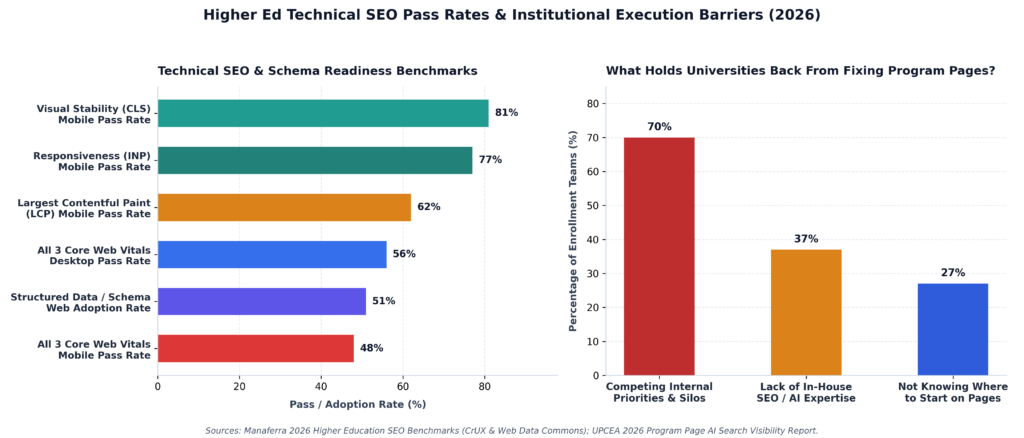
Figure 1: Higher ed search visibility and AI shortlist benchmarks, illustrating the 72% relative CTR drop on Position #1 organic listings when AI Overviews appear
How Do 2026 Higher Education Search & AI Visibility Metrics Compare Visually?
The visual distribution below illustrates how dramatically student discovery has shifted toward non-branded search, zero-click AI summaries, and LLM shortlist evaluation:
| Discovery & Search Behavior Metric (2026) | Visual Share (0%–100% Scale) | Benchmark | Primary Research Source |
| Undergraduates Using Multiple Platforms in Search | █████████████████░░░ | 87.0% | Manaferra 2026 Benchmarks |
| Undergraduates Whose Shortlist Was Influenced by AI | ████████████████░░░░ | 82.0% | Manaferra 2026 Benchmarks |
| Top 100 .edu Organic Traffic Stuck in Branded Queries | ████████████████░░░░ | 81.2% | Manaferra Program Page Guide |
| Prospective Students Reading Google AI Overviews | ████████████████░░░░ | 79.0% | UPCEA 2026 AI Search Study |
| Prospects Trusting .edu Program Pages Over 3rd Parties | ███████████████░░░░░ | 77.0% | UPCEA 2026 AI Search Study |
| U.S. Google Searches Ending Without a Website Click | ██████████████░░░░░░ | 68.0% | Manaferra / SparkToro Data |
| Prospects First Visiting Program Pages on Mobile | ████████████░░░░░░░░ | 60.0%+ | Manaferra Program Page Guide |
| Undergrads Discounting Schools Absent From AI (2026) | ████████████░░░░░░░░ | 59.0% | Manaferra 2026 Benchmarks |
| Adult Learners Using an AI Search Engine for College | ██████████░░░░░░░░░░ | 48.0% | Manaferra 2026 Benchmarks |
| Mobile Pages Passing All Three Core Web Vitals | ██████████░░░░░░░░░░ | 48.0% | Manaferra 2026 Benchmarks |
| Pos. #1 Organic CTR Without AI Overviews | █████████░░░░░░░░░░░ | 43.7% | Manaferra 2026 Benchmarks |
| Prospects Starting Search With No School in Mind | ████████░░░░░░░░░░░░ | 40.0% | Manaferra 2026 Benchmarks |
| Pos. #1 Organic CTR When AI Overviews Appear | ██░░░░░░░░░░░░░░░░░░ | 12.0% | Manaferra 2026 Benchmarks |
How Do Bloated .edu URL Structures and Slow Mobile Pages Kill Enrollment Conversions?
University websites are notorious for labyrinthine information architecture. When URLs mirror internal organizational charts rather than student browsing logic, search engine crawl budget is wasted and page authority is diluted across duplicate departmental subdomains.
Compare these two URL structures documented in Manaferra’s Higher Ed Program Page SEO Guide:
- Legacy Institutional URL (Poor SEO)
- Student-Centric Semantic URL (Optimal SEO)
Compounding deep URL nesting is poor mobile technical performance. While over 60% of prospective students first interact with university program pages on mobile devices, cross-web benchmarks show that only 48% of mobile pages pass all three Core Web Vitals (compared to 56% on desktop), with Largest Contentful Paint (LCP) recording the lowest mobile pass rate at 62% (Manaferra 2026 Benchmarks). Heavy campus video backgrounds, unoptimized hero carousels, and clunky third-party CRM scripts bog down mobile rendering. Rebuilding these templates through conversion-focused education website design and CMS architecture is often the single fastest way to unlock trapped organic rankings and lift inquiry form completions.
“Rebuilding these templates through education website design is often the single fastest way to unlock trapped organic rankings and lift inquiry form completions.
| Bottleneck Category | Common .edu Failure Mode | Verified Industry Impact (2025–2026) | Root Fix for Enrollment & Marketing Leaders |
| Keyword & Intent Strategy | Relying on internal degree titles (e.g., M.S. in Applied Quantitative Systems) instead of student search terms | 81.2% of .edu organic traffic is trapped in branded queries; 40% of prospects start with zero schools in mind | Map each degree page to transactional, modality-specific non-branded keywords (e.g., “online master’s in data science”) |
| AI & SERP Visibility | Unstructured prose blocks and missing EducationalOccupationalProgram / FAQPage JSON-LD schema | Position #1 CTR drops from 43.66% to 12.01% with AI Overviews; 59% of students discount schools absent from AI search | Structure program facts (tuition, credits, duration, modality) in labeled HTML blocks backed by valid JSON-LD schema |
| URL & Technical Architecture | 6-level organizational chart URLs, slow mobile LCP, and conflicting PDF course catalogs | Over 60% of prospects browse on mobile, yet only 48% of mobile pages pass Core Web Vitals | Flatten URLs (/online-degrees/masters/psychology), compress scripts, and canonicalize or de-index outdated catalog PDFs |
| Regulatory & Trust Compliance | Publishing generic national BLS salary averages as institutional graduate outcomes or hiding OPM roles | Triggers federal enforcement under 34 C.F.R. § 668.71 and DCL GEN-25-01, risking Title IV fines and 3-year ad audits | Substantiate all graduate employment/salary claims with verified institutional data and clearly disclose third-party partnerships |

What Do Prospective Students and AI Search Engines Look for on an Academic Program Page?
According to UPCEA and Search Influence’s 2026 research, 63% of prospective students rely directly on university websites during their evaluation phase, and 77% trust university-owned content over third-party directories. Your academic program page is now doing double duty: it must persuade an anxious, time-pressed human applicant to request information while simultaneously serving as a structured, machine-readable fact database for Google Search, Google AI Overviews, ChatGPT, Perplexity, and Gemini.
What Essential Content Sections Must Every High-Converting Degree Page Include?
Empirical analysis from Manaferra’s study of top-performing .edu program pages demonstrates that comprehensive, modular program pages consistently outrank thin overview pages—with detailed curriculum breakdowns and verified career outcome sections showing the strongest correlation with Page 1 rankings. Every priority degree page should include seven clearly labeled, self-contained modules:
| Program Page Section | Required Data & Copy Elements | Why It Drives Rankings, AI Citations & Student Inquiries |
| 1. Above-the-Fold Program Snapshot | Exact degree title, delivery modality (Online, Hybrid, On-Campus), total credit hours, estimated completion time, next start date, and primary RFI CTA | Captures the 60%+ mobile audience immediately and provides clean, chunked facts for AI Overviews |
| 2. Interactive Curriculum & Course Breakdown | Core courses, electives, specializations/concentrations, learning outcomes, and capstone/clinical requirements in expandable HTML accordions (not PDFs) | Ranks for long-tail curriculum searches and helps prospects visualize the academic workload |
| 3. Transparent Cost, Tuition & Financial Aid | Per-credit cost, total estimated tuition, mandatory fees, scholarship eligibility, employer tuition assistance, and military/veteran benefits | Satisfies federal transparency mandates and eliminates the #1 barrier causing prospects to bounce |
| 4. Verified Career Outcomes & ROI Data | Institutional graduate placement rates, verified alumni salary ranges, specific job titles, industry partnerships, and licensure pass rates | Connects the degree to career ROI—the top priority for adult and undergraduate learners |
| 5. Admission Requirements & Transfer Policies | GPA minimums, test-optional/GRE/GMAT policies, required transcripts, application deadlines, and maximum transfer credit allowances | Removes application anxiety and enables qualified applicants to self-select into the enrollment funnel |
| 6. Faculty Profiles & Practitioner Credentials | Named faculty teaching in the specific modality, terminal degrees, active research grants, and real-world industry experience | Reinforces E-E-A-T (Experience, Expertise, Authoritativeness, Trustworthiness) for Google and complies with parity rules |
| 7. Accreditation & Student FAQ Block | Regional and programmatic accreditation badges (e.g., AACSB, CCNE, ABET) plus 5–8 conversational Q&As mirroring natural student prompts | Builds institutional trust and feeds direct Q&A pairs into Google AI Overviews and LLM retrieval pipelines |
Which Schema Markup Is Required for University Degree Pages to Appear in AI Search?
Across the general web, structured data appears on roughly 51% of web pages, and in controlled testing cited in Manaferra’s 2026 SEO Benchmarks, pages with properly validated schema markup were the only candidates surfaced inside Google AI Overviews. As UPCEA explains, schema markup is the explicit semantic label that prevents AI models from guessing about your tuition, modality, or prerequisites.
Every academic degree page should deploy validated JSON-LD structured data combining four core schema types:
- EducationalOccupationalProgram & Course Schema: Explicitly defines the program name, timeToComplete (e.g., P18M for 18 months), numberOfCredits, educationalCredentialAwarded, educationalProgramMode (online, blended, or full-time), and offers (tuition price per credit and total cost).
- EducationalOrganization Schema: Connects the program page to your university’s verified Knowledge Graph entity, institutional accreditation, and campus locations.
- ItemList Schema: Structures your required core courses and specialization tracks so search engines can display rich curriculum snippets directly on the SERP.
- FAQPage Schema: Wraps your on-page student FAQs so answer engines (ChatGPT, Perplexity, Gemini, and Google AI Overviews) can ingest verified question-and-answer pairs without hallucinating details.
What Are the Latest U.S. Federal Regulations for Higher Education Marketing Agencies and Program Pages?
For university CMOs, VPs of Enrollment, and the marketing agencies they hire, 2025 and 2026 represent a watershed shift in federal regulatory enforcement. You can no longer allow copywriters or external agencies to write aggressive, unverified SEO copy on degree pages simply to boost click-through rates or conversion percentages. Under federal law, your university’s website is an official legal disclosure surface, and every statement on an academic program page—whether written in-house or by an outside SEO agency—is subject to strict scrutiny by the U.S. Department of Education (ED), the Federal Trade Commission (FTC), and state Attorneys General.
How Does Department of Education Dear Colleague Letter GEN-25-01 Impact Higher Ed Marketing Agencies?
On January 16, 2025, the U.S. Department of Education issued Dear Colleague Letter GEN-25-01, reinforcing institutional and third-party liability under Section 487(c)(3) of the Higher Education Act (20 U.S.C. § 1094(c)(3)) and the Department’s Subpart F Misrepresentation Regulations (34 C.F.R. § 668.71).
Under 34 C.F.R. § 668.71(c), a prohibited misrepresentation is any false, erroneous, or misleading statement—including any statement that omits material information in a way that makes it misleading—made directly or indirectly to a prospective student by an eligible institution or by any external organization contracted to provide marketing, advertising, recruiting, or admissions services. As GEN-25-01 explicitly warns, these rules apply “with equal force” to Online Program Managers (OPMs), digital marketing agencies, and lead generators, and the university bears direct Title IV liability for any misrepresentation committed by its marketing partners.
Specifically, DCL GEN-25-01 flags three high-risk practices that frequently appear on university program pages and in enrollment funnels:
- False Equivalency Between Online/OPM Programs and Campus Programs: Describing an online degree program managed or supported in substantial part by an external provider as “the same as” or “identical to” your residential campus program is a substantial misrepresentation unless there is documented parity across faculty qualifications, curriculum, admissions criteria, completion rates, licensure pass rates, and graduate earnings. Furthermore, under 34 C.F.R. § 668.43(a)(12), program pages must make readily available accurate disclosures if a third party provides a portion of the educational program.
- Misleading Titles for Enrollment & Marketing Representatives: Presenting sales-compensated recruiters or agency lead-qualification staff as “Academic Advisors” or “Admissions Counselors” on program page chat widgets, RFI forms, or follow-up emails violates federal misrepresentation standards, the Title IV Incentive Compensation Ban (34 C.F.R. § 668.14(b)(22)), and state consumer protection laws such as Massachusetts (940 CMR 31.06(10)) and New York (8 NYCRR § 126.12(e)).
- Implied Institutional Employment: Allowing external agency or OPM staff to communicate with prospective students using @university.edu email addresses or institutional signatures without clearly disclosing their third-party employer status constitutes deceptive attribution.

Can Universities Use Bureau of Labor Statistics (BLS) Salary Data on Degree Pages Under 34 CFR 668.71?
One of the most common—and legally perilous—SEO mistakes on university degree pages happens in the “Career Outcomes” section. Well-meaning SEO writers frequently look up national median salaries from the U.S. Bureau of Labor Statistics (BLS) and place a bold callout on the degree page saying, “Graduates with a Master’s in Cybersecurity earn $120,000 per year.”
According to Holland & Knight’s legal analysis of U.S. Department of Education misrepresentation enforcement and the FTC’s Notice of Penalty Offenses Concerning Education under Section 5 of the FTC Act (15 U.S.C. § 45) and 16 C.F.R. Part 254, three specific content practices on degree pages are actively targeted by federal regulators:
- Misrepresenting National BLS Data as Institutional Graduate Salaries: Publishing broadly applicable national or regional BLS wage data in a manner that leads a prospective student to believe those figures represent the actual salaries earned by your university’s graduates is a textbook violation of 34 C.F.R. § 668.74 (Employability of Graduates). Recent ED enforcement actions resulted in heavy institutional fines, borrower defense loan discharges, and a mandatory three-year federal pre-review of all university marketing materials. If you cite BLS data to illustrate general industry growth, you must explicitly label it as national BLS data and clearly distinguish it from your institution’s own verified graduate outcomes.
- Unsubstantiated Peer Comparisons and “No. 1” Ranking Claims: Claiming on a title tag or H1 that your degree is the “No. 1 Nursing Program in the Region” or comparing job placement rates against peer institutions without rigorous, auditable substantiation violates both ED guidelines and FTC truth-in-advertising standards.
- Omission of Licensure & Prerequisite Limitations: Under 34 C.F.R. § 668.72 (Nature of Educational Program) and 34 C.F.R. § 668.43, if a degree prepares students for a licensed profession (such as nursing, teaching, counseling, or accounting), omitting state-by-state licensure eligibility disclosures or failing to state additional clinical/exam requirements needed to secure employment is a misrepresentation by omission.
How Do Financial Value Transparency (FVT), Gainful Employment (GE), and the 2026 STATS Rules Affect Program Pages?
Beyond anti-deception rules, your program pages must align with federal financial accountability data. Under the U.S. Department of Education’s Financial Value Transparency and Gainful Employment (FVT/GE) Regulations—which remain in effect through June 30, 2027, before transitioning on July 1, 2027, to the newly published Student Tuition and Transparency System (STATS) and Earnings Accountability Final Regulations (published July 1, 2026; EA ID: GENERAL-26-49)—institutions must report granular program-level data on total tuition, fees, books/supplies, median graduate debt, and post-completion earnings thresholds.
For enrollment marketers, this means your program page tuition and cost disclosures (34 C.F.R. § 668.73) must match your federal NSLDS reporting to the dollar. Hiding mandatory technology fees, clinical fees, or out-of-state tuition differentials in footnotes—or leaving outdated 2023 tuition rates on a live degree page while your bursar charges 2026 rates—creates both an immediate federal compliance liability and an AI trust failure when LLMs cross-reference your site against federal education databases.
| U.S. Federal Regulation / Authority | Core Legal Mandate for Higher Ed Marketing | Unlawful / High-Risk Program Page Practice | Compliant, SEO-Safe Program Page Standard |
| ED 34 C.F.R. § 668.71 & DCL GEN-25-01 (Jan 2025) | Prohibits false, erroneous, or misleading statements (including omissions) by universities or their marketing agencies/OPMs | Claiming an OPM-run online degree is “identical” to the residential campus program, or labeling sales recruiters as “Academic Counselors” | Clearly distinguish online vs. campus delivery resources, disclose third-party written arrangements (34 C.F.R. § 668.43(a)(12)), and use accurate staff titles |
| ED 34 C.F.R. § 668.74 & Sept 2024 Guidance | Prohibits misrepresenting the employability or compensation of graduates | Displaying national BLS median salaries under a heading like “What Our Graduates Earn” or making unverified “No. 1 Ranked” claims | Label BLS statistics explicitly as national occupational averages and pair them with audited, cohort-specific institutional graduate outcomes |
| FTC Section 5 & Notice of Penalty Offenses (16 C.F.R. Part 254) | Prohibits deceptive acts and unsubstantiated claims regarding career demand, job placement, and institutional affiliations | Promising guaranteed job placement or using unverified employer logos to imply formal hiring partnerships | Cite the exact graduation cohort year, response rate, and methodology behind every placement statistic and verify all employer partnership claims |
| ED FVT/GE & 2026 STATS Rules (34 C.F.R. § 668.73) | Mandates transparent, accurate reporting of total program cost, debt, and graduate earnings accountability | Advertising base per-credit tuition while omitting mandatory program fees, lab costs, or clinical expenses | Publish a complete, itemized cost-of-attendance table on every program page synchronized with your financial aid office and NSLDS filings |
How Can Enrollment Leaders Fix Underperforming Academic Program Pages Step by Step?
According to UPCEA’s 2026 survey of enrollment teams, most higher education leaders already know their program pages need an overhaul for organic and AI search—yet 70% are stalled by competing internal priorities, 37% lack specialized in-house SEO/AI expertise, and 27% simply do not know where to start. Instead of trying to rewrite 150 degree pages simultaneously and getting bogged down in endless committee reviews, partnering with an agency that delivers comprehensive academic program page SEO audits allows you to execute a phased, high-ROI turnaround starting with your highest-revenue degree programs.
Partnering with an agency that delivers comprehensive academic program page SEO audits allows you to execute a phased, high-ROI turnaround starting with your highest-revenue degree programs.

How Do You Research High-Intent Non-Branded Keywords for Online and Campus Degree Programs?
Stop optimizing program pages for broad, high-volume vanity keywords that carry mixed informational intent. The broad term “data science degree” generates 3,600 monthly searches, but the SERP is cluttered with general career guides, Wikipedia definitions, and forum debates. By contrast, “online data science degree” generates 1,900 monthly searches with pure transactional intent—meaning every searcher is actively comparing accredited universities to enroll in.
When conducting keyword research across your academic portfolio:
- Prioritize Modality + Credential + Discipline Combinations: Target explicit transactional modifiers such as “online master’s in counseling,” “accelerated BSN program,” or “evening MBA for working professionals.”
- Separate Informational Blog Queries From Transactional Degree Pages: Queries like “is an MBA worth it in 2026” or “what can you do with a psychology degree” belong on supporting blog guides that link internally to your degree page—never as the primary target keyword of the degree page itself.
- Audit Competitor Share of Voice (SOV): Across a tracked set of five competing universities, 20% Share of Voice is the mathematical parity point. Compare your non-branded SOV against your IPEDS enrollment share to calculate your Excess Share of Voice (ESOV) and identify which specific degree lines are ceding market share to rival schools.
How Should Universities Structure Title Tags, Meta Descriptions, and H1-H3 Headings for Degree Pages?
Every on-page metadata element and heading on your program page should be engineered to win both the human click on Google and the semantic chunk extraction of AI models:
- Title Tag Formula (Under 60 Characters): Front-load the exact student search query and modality before your brand name: [Modality] [Degree Type] in [Program Name] | [University Name] (e.g., Online Master’s in Psychology | ASU Online).
- Meta Description Formula (150–160 Characters): Combine the primary keyword, two concrete, compliant proof points (accreditation, credit count, or flexibility), and a direct action verb.
- Semantic H1–H3 Hierarchy: Ensure your CMS outputs true HTML <h1>, <h2>, and <h3> tags—never <div> or <span> elements styled to look like headers . Use natural student questions as your <h2> and <h3> subheadings (e.g., “How Much Does the Online MSN Program Cost?”, “What Courses Are Required for the B.S. in Computer Science?”) followed immediately by a plain-language, 2-sentence factual summary before expanding into details.
How Do You Optimize Multi-Campus and Regional Degree Pages for Local Search and In-State AI Recommendations?
One of the most striking findings in Manaferra’s 2026 State of College Search report is that AI search engines recommend schools from a prospective student’s home state 5 times more often than out-of-state institutions. Even for hybrid, evening, and online programs, regional proximity, state licensure alignment, and local employer recognition remain massive ranking and conversion catalysts.
To capture high-intent regional and commuter students, universities should pair their on-page degree optimization with multi-campus local SEO services for universities:
To capture high-intent regional and commuter students, universities should pair their on-page degree optimization with local SEO services for universities:
- State-Specific Licensure & Employer Signals: Explicitly state how your nursing, education, social work, or accounting curriculum meets state board licensure requirements in your primary recruitment states, and highlight regional clinical or internship hospital/corporate partners.
- Campus-Specific Landing Pages & Google Business Profiles: If you operate satellite campuses or regional adult learning centers, optimize distinct Google Business Profiles for each physical campus and link them to localized program pages with embedded CollegeOrUniversity and Place schema markup.
- In-State Tuition & Reciprocity Clarity: Clearly display in-state tuition rates, regional tuition reciprocity agreements (such as WICHE, SREB, or MSEP), and county-level transfer articulation pathways with local community colleges.
When Should You Combine Education SEO With Google Ads to Fill Immediate Enrollment Cohorts?
Rebuilding organic authority and AI search citation share is the highest-ROI long-term investment a university can make—especially when higher education landing pages convert at a 6.3% median conversion rate across channels. However, organic re-indexing and authority compounding take 3 to 6 months, and your Provost will not wait two semesters to fill an upcoming cohort.
The smartest enrollment leaders bridge this gap by running a unified search strategy: deploying high-intent Google Ads management for higher education to capture immediate bottom-of-funnel demand for upcoming application deadlines
The smartest enrollment leaders bridge this gap by running a unified search strategy: deploying high-intent Google Ads management for higher education to capture immediate bottom-of-funnel demand for upcoming application deadlines, while simultaneously using the conversion data and search term reports from those paid campaigns to refine the on-page SEO copy, FAQ blocks, and conversion rate optimization (CRO) of the underlying academic program pages. When your paid search landing pages and organic degree pages share the same fast, mobile-first architecture and compliant value propositions, your Quality Scores rise, your cost-per-inquiry (CPI) drops, and your organic rankings accelerate.
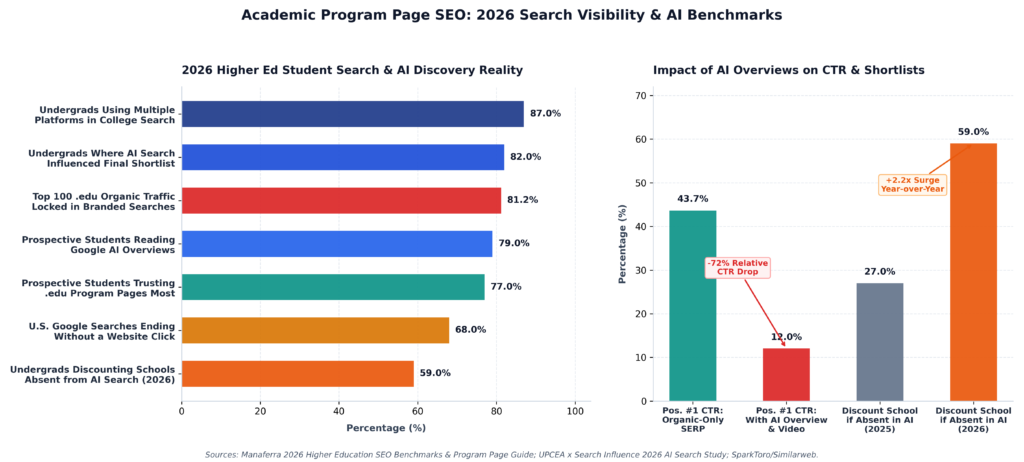
Figure 2: Technical SEO pass rates across .edu domains and the primary internal barriers preventing university enrollment teams from optimizing degree pages
How Do You Benchmark Academic Program Page SEO and AI Visibility Against Competing Universities?
Tracking traditional keyword positions in isolation is an obsolete way to measure higher education marketing performance in 2026. A program page can sit at Position #2 on Google and still lose 50% of its historical clicks if an AI Overview answers the query above the fold and recommends three rival universities instead.
Use this 2026 Higher Education Search & AI Scorecard to benchmark your priority degree pages every quarter:
| KPI / Benchmark Metric | 2026 Higher Ed / Web Baseline | Target Performance for Growth-Focused Universities | How to Measure & Audit Your Institution |
| Non-Branded Organic Traffic Share | 18.8% non-branded (81.2% branded across top 100 .edu sites) | 40%–65%+ non-branded traffic on academic program page subfolders | Filter Google Search Console clicks by Program URL subfolder and exclude institutional brand name variations |
| Competitive Share of Voice (SOV) | 20% parity across a 5-school peer set | Positive Excess Share of Voice (ESOV) (Non-branded SOV exceeding your IPEDS enrollment share) | Track 50–100 non-branded transactional degree keywords against 4 peer schools in Ahrefs or Semrush |
| Position #1 Organic CTR (With vs. Without AIO) | 43.66% (organic-only SERP) vs. 12.01% (when AI Overviews & video appear) | Outperform SERP-feature adjusted CTR baseline and secure direct citation links inside the AI Overview | Segment GSC queries by SERP feature presence and audit whether your program page is cited in the AI Overview |
| Program-Level AI Search Visibility & Citation Mix | Typical schools get 60% (6 in 10) of AI citations from their own .edu domain | Appear in >20% of in-state/program AI prompts; earn 70% (7 in 10) of AI citations from trusted third-party sources | Test priority student prompts across ChatGPT, Gemini, and Perplexity, and build third-party authority mentions |
| Mobile Core Web Vitals & Schema Validity | 48% mobile CWV pass rate; 62% mobile LCP pass rate; 51% schema adoption | 90%+ mobile CWV pass rate on program templates; 100% valid Course & FAQPage JSON-LD schema | Audit program templates in Google Search Console CWV report and validate markup in Google’s Rich Results Test |
| Program Page Inquiry Conversion Rate | 6.3% median higher education landing page conversion rate | 7.5%–10%+ organic visitor-to-RFI conversion rate with CRM tracking through to enrollment yield | Configure GA4 key events for RFI submissions and application starts segmented by Organic Search and AI Referrals |
Frequently Asked Questions Prospective Enrollment Leaders Ask About Academic Program Page SEO
How Long Does It Take to See Enrollment Results From Optimizing Academic Program Pages?
Technical and on-page fixes—such as flattening URL structures, adding EducationalOccupationalProgram and FAQPage JSON-LD schema, rewriting title tags for transactional intent, and replacing buried catalog prose with labeled fact modules—typically produce measurable gains in Google impressions, AI Overview citations, and non-branded keyword rankings within 60 to 90 days. Because university .edu domains already possess strong foundational domain authority, removing technical crawl barriers and aligning content with student search intent unlocks rapid ranking velocity compared to new commercial domains. Full downstream impact on submitted applications and enrolled cohorts typically materializes across one to two recruitment cycles (4 to 9 months), which is why pairing organic optimization with targeted paid search is recommended for immediate cohort deadlines.
Will Optimizing Our Degree Pages for ChatGPT and AI Overviews Hurt Our Traditional Google Rankings?
No—optimizing for AI search (Generative Engine Optimization, or GEO) and traditional Google SEO are mutually reinforcing . Because AI platforms like ChatGPT, Perplexity, and Google AI Overviews rely heavily on retrieval-augmented generation (RAG) grounded in authoritative web indices, the exact signals that help LLMs extract and cite your program facts—clean H1–H3 semantic hierarchy, plain-language tuition and credit tables, validated JSON-LD schema, fast mobile Core Web Vitals, and consistent entity data across your catalog and third-party sites—are the same foundational signals that Google’s core ranking systems reward.
How Can We Convince Faculty Committees to Replace Academic Catalog Jargon With SEO-Friendly Program Copy?
The most effective way to win faculty buy-in is to frame program page optimization around student clarity, federal compliance, and academic fit rather than “marketing tricks.” Share data showing that 77% of prospective students trust university-owned program pages to understand prerequisites, curriculum rigor, and career paths, and demonstrate how ambiguous catalog language causes qualified students to abandon the page or causes AI assistants to misstate the faculty’s curriculum. Keep the official academic catalog as the registrar’s governance document, while positioning the .edu program page as the student-facing translation layer that attracts better-prepared applicants into their classrooms.