
You’ve started drafting the termination email. Then you stop.
Another invoice has arrived. Your team is still asking where the qualified leads are. You have raised your concerns, waited for improvements, and sat through meetings that left you with more questions than answers.
You are ready for a change. But there is something you need to know first.
Will my website stay online? Can I keep my Google Ads history? What happens to the domain they registered for me?
The answers depend on your account permissions, contract, and the services your agency controls. Those details can be checked before you give notice.
Maybe that uncertainty is why you have postponed the conversation. You are disappointed with the relationship, but interrupted campaigns or a website outage would make an already difficult situation worse. Paying another month can start to feel easier than risking a messy exit.
Before paying that next invoice, find out what a handover would actually require.
Confirm your business has working access. Review the termination terms. Identify what needs to be transferred, what can stay in place, and which dependencies could interrupt customer inquiries.
This guide walks you through those decisions in plain English. You will learn what to check before giving notice, how to preserve your existing SEO work and advertising records, and how to prepare the handover before removing the outgoing agency’s access.

Marketing Agency Won’t Give Me Access to My Google Ads Account—Is This Normal?
An agency may manage your advertising through its own manager account. That arrangement can be legitimate. The important question is what control your business has over the individual advertising account.
A dashboard showing leads and spending does not demonstrate administrative access. Ask for the account ID, the users and manager accounts with access, the billing arrangement, and your actual permission level.
Google distinguishes manager-account ownership from the client account’s own rights and data. Its documentation explains that manager ownership does not take the client account’s data ownership or administrative rights away.
Also distinguish platform permissions, contractual rights, and intellectual-property ownership. These are separate issues. Having your credit card charged for advertising is useful evidence of the business relationship, but it does not resolve every dispute about accounts or creative assets.
Google’s third-party policies require separate accounts for individual advertisers and impose transparency requirements. Those are platform rules; they should be evaluated alongside the agreement and applicable law.
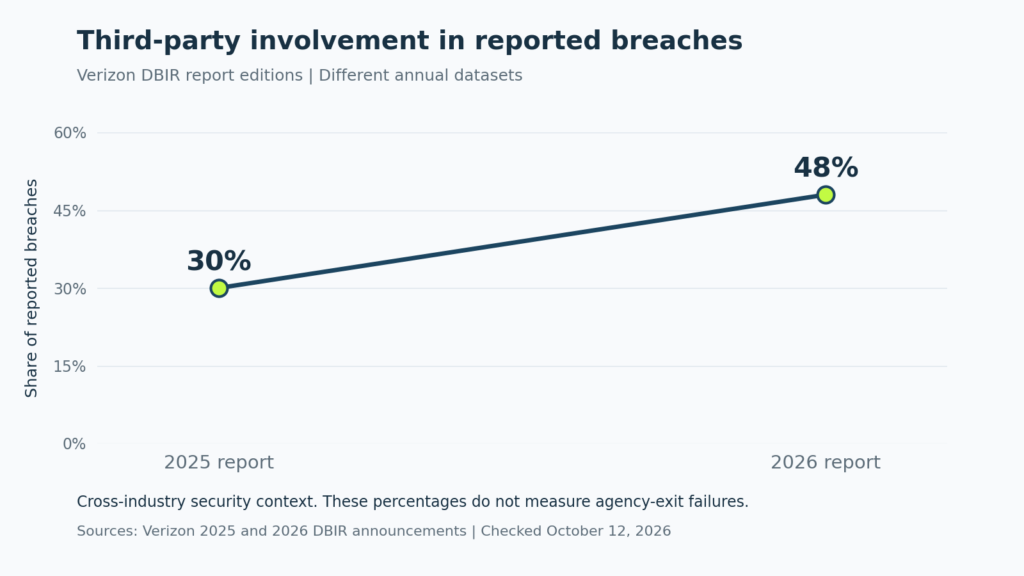
The wider security environment also supports reviewing vendor access carefully. The following figures provide context from cross-industry research. They measure breaches studied by the publishers, rather than the likelihood of a marketing-agency exit going wrong.
| Published research | Reported finding | Scope and practical relevance |
| Verizon 2025 DBIR | 30% of breaches involved a third party | Review which vendors retain access to business systems. |
| Verizon 2026 DBIR | 48% of breaches involved a third party | Maintain an accurate record of external access and dependencies. |
| IBM 2026 Cost of a Data Breach Report | $4.99 million global average breach cost | Financial context across studied organizations; not an estimate of your agency-transition costs. |
These figures come from the publishers’ reports and announcements.
The Verizon percentages compare different annual datasets. They support taking access governance seriously without predicting what will happen to an individual business.
Regaining Ownership of Online Accounts?
Start with an asset inventory before making account changes. The uncomfortable discovery is often that the agency controls more than the advertising interface.
Your domain, hosting, analytics, lead-routing system, and telephone numbers may sit in different accounts. A single “everything has been transferred” email is insufficient evidence that each system remains usable.
Use an inventory that records the account identifier, responsible business administrator, agency permissions, dependencies, and the action needed at handover.
| Asset | What your business should verify | Evidence to retain |
| Domain registration | Registered holder, registrar access, renewal billing, recovery details | Registrar account record and renewal confirmation |
| DNS and business email | Who can edit records and manage email-related settings | Current DNS export and named administrator |
| Website and hosting | Administrative access, backups, database, custom code, hosting responsibility | Backup that has been checked for restoration |
| Google Ads | Client account ID, business access, linked managers, payment setup | Access list and campaign configuration records |
| Meta assets | Business portfolio, ad account, Page, Instagram, datasets, catalogs | Asset IDs and asset-specific permissions |
| GA4 and Search Console | Business access to the existing property and verified website | Property IDs, reports, and verification-method record |
| Google Tag Manager | Account administration and needed container permissions | Published container export and administrator list |
| Google Business Profile | Primary ownership and other user roles | People-and-access record for the existing profile |
| CRM and automation | Authorized exports, integrations, workflows, consent and suppression records | Secure export and workflow documentation |
| Call tracking and creative files | Number arrangements, recordings where permitted, source files and licenses | Provider terms and agreed deliverables register |
Verify access by signing in through business-controlled identities. Use individual invitations and multifactor authentication rather than circulating a shared password.
Google specifically recommends at least two active administrators for Tag Manager and says someone in your organization should manage the account. Account-level administration and container-level publishing permissions are distinct.
For GA4, assess whether adding appropriate business access is sufficient. An eligible property can also be moved between Analytics accounts, preserving reporting data; the move has requirements and permission choices that need review.
If the incoming team will handle WordPress website design, include the existing site’s code, content, backups, and licensed components in the agreed handover scope.

How Does a Business Change to a New SEO Company Without Throwing Years of Work Out the Window?
Protect the website’s working foundations before introducing a new strategy.
Changing service providers does not itself require a new domain, new URLs, or a different content management system. Those additional changes create their own technical work and should have a clear business reason.
Ask the incoming provider to document existing high-value pages, search performance, redirects, indexability settings, and unresolved issues. Keep a dated record of what is live when responsibility changes.
The fear of “losing all your SEO” can make business owners accept poor service indefinitely. Request a specific explanation of any claimed dependency. Is the agency referring to ongoing content production, a licensed website platform, external assets, or a technical configuration it controls? Each has a different solution.
For actual site migrations, Google recommends changing one thing at a time and warns that significant moves can cause temporary ranking fluctuations.
A practical continuity review should cover the following areas.
| SEO component | Handover action | What to monitor afterward |
| Important URLs and redirects | Preserve functioning destinations; document necessary changes | Unexpected errors or broken referral paths |
| Indexability and canonical settings | Record current rules and verify the live site after changes | Important pages becoming excluded or pointing elsewhere |
| Valuable content | Retain content your business is entitled to use | Accidental removal of pages that attract relevant demand |
| Search Console and analytics | Preserve access to existing records and properties | Reporting gaps and unexplained changes |
| Local visibility | Keep the existing Business Profile and accurate business details | Changes in calls, website visits, and customer inquiries |
Agree on a monitoring baseline using your own data. Compare equivalent periods where possible, and consider seasonality, campaign changes, and tracking changes before assigning a cause to a traffic movement.
When evaluating SEO services, ask how the provider will preserve useful work while documenting what it plans to change. A clear transition plan is more useful than a promise that rankings can never fluctuate.
Will We Need to Create an Entirely New Google Ads Account Before We Start Running New Campaigns?
Often, the existing individual client account can remain in place while management changes.
Google states that unlinking a client account from a manager does not remove the client account’s campaign history. However, shared resources and billing arrangements can be affected.
Before unlinking, have the incoming provider inspect the dependencies. This is particularly important when the agency supplied measurement or audiences through its manager account.
| Dependency | Possible effect of unlinking | Preparation needed |
| Manager-level conversion tracking | The shared tag stops recording conversions for clicks occurring after unlinking | Establish and validate the appropriate replacement setup |
| Manager-owned shared audiences | Access to shared lists can end, affecting campaigns using them | Review targeting and exclusions before the change |
| Monthly invoicing through a paying manager | Advertising can stop when the paying manager is removed | Arrange the necessary billing setup before unlinking |
These effects are described in Google’s unlinking guidance.
Preserve campaign settings, change-history records, conversion definitions, exclusions, and relevant reports. Separate keeping account history from guaranteeing the continued availability of every agency-owned tool or shared resource.
An incoming Google Ads management provider should explain its permission needs and what must happen to billing and measurement before taking over.
If access is disputed, retain the agreement, account identifiers, invoices, and correspondence. Ask Google support to evaluate the available recovery or policy process. Recovery depends on the facts and platform requirements.
Is It Possible to Change Ownership of an Ad Account?
For Meta, first identify the exact asset and the control currently available.
A Facebook Page, Instagram account, ad account, business portfolio, and dataset are different assets. Permission to post on a Page does not establish control over every advertising asset connected to it.
Meta’s guidance distinguishes Facebook access with full or partial control from task access. People with full control can manage access, including removing other people. Review those roles carefully before granting them.
For ad accounts and business portfolios, have the incoming team check the current platform options for the particular asset. Partner access and an ownership transfer are different arrangements. Do not assume that every agency-created asset can be moved through the same process.
Where a transfer is unavailable, document whether authorized access can preserve operations or whether a business-controlled replacement is necessary. Explain which historical information, integrations, audiences, and creative can be retained under the applicable permissions and terms.
The emotional cost of starting again matters. A business owner should receive an explanation before being asked to abandon an account built over years.
When discussing Meta Ads management, ask the provider to map the assets and permissions first. Avoid replacing the entire setup merely because doing so is easier for the incoming team.

Why Is My Registrar Refusing to Transfer My Domain Name?
Separate control of the domain from moving it to a different registrar.
Your business may be able to retain its domain at the existing registrar while changing agency access. A registrar transfer is a separate operation, and changing the nameservers or hosting is another.
Confirm who is recorded as the registered holder, which account manages the domain, who receives recovery notices, and when registration expires. Preserve the existing DNS records before any authorized changes, including records used by business email.
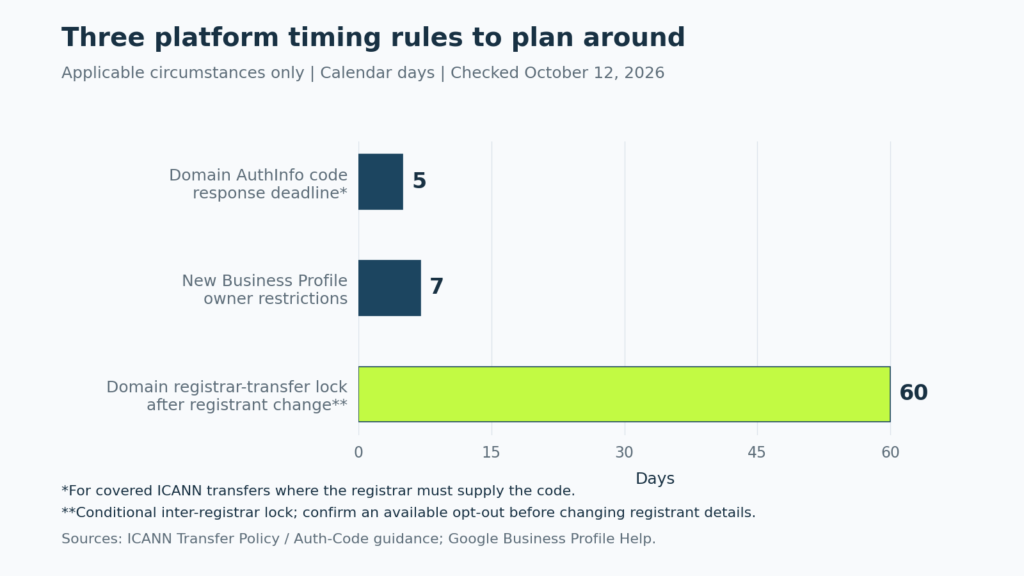
ICANN’s Transfer Policy applies to covered domain registrations. It includes restrictions associated with recent registration, recent registrar transfers, and certain changes of registrant. A 60-day inter-registrar lock can follow a registrant change; an available opt-out needs to be addressed before that change.
For covered transfers, registrars either provide a way to generate an Auth-Code or must supply it within five calendar days of a request. ICANN identifies a complaint route when the required code is not provided.
Plan around these published timing rules while distinguishing deadlines from restrictions.
| Rule | Published timing | What it means |
| Auth-Code supplied by the registrar, where required | 5 calendar days | A response deadline under applicable ICANN requirements |
| Restrictions on newly added Business Profile owners or managers | 7 days | Some ownership and user-management actions are temporarily restricted |
| Registrant-change registrar-transfer lock, where applicable | 60 days | A conditional restriction on transferring between registrars |
The Google Business Profile limitation is relevant to local marketing access; it is a separate platform rule from domain transfer.
For local SEO services, preserve control of the existing Business Profile as well as the domain. Verify ownership early enough to account for platform restrictions.
If the agency controls registration and disputes your entitlement, request the supporting agreement and contact the registrar about its verification process. A contractual ownership dispute may also require legal advice. A transfer-policy complaint cannot resolve every dispute with a marketing provider.
Am I Expecting Too Much From This Marketing Agency?
A professional handover should identify what is being delivered, what rights accompany it, and what remains dependent on a separate license or subscription.
Review the contract’s termination provisions, notice method, renewal terms, outstanding charges, ownership language, confidentiality requirements, and transition obligations. Document any additional handover work you agree to purchase.
The current U.S. legal framework involves several distinct areas. Apply each within its actual scope.
| Legal area | Relevant principle | Practical question |
| FTC advertising requirements | Claims must be truthful and supported; agencies can share responsibility for misleading advertising | Are performance claims and promised deliverables supportable? |
| Copyright ownership and transfer | Copyright transfers generally require a signed writing; work-made-for-hire status has defined conditions | Can your business reuse and modify the delivered creative? |
| Applicable state contract law | Rights depend on the agreement and governing jurisdiction | What notice, payment, deliverable, and dispute terms apply? |
| California CCPA, where applicable | Covered processing relationships require appropriate contractual protections | What can each provider do with customer information after exit? |
The federal advertising, copyright, and California privacy requirements above address different obligations.
Paying for creative work does not automatically make every contractor-produced asset a work made for hire. Confirm any ownership assignment or continuing license, and distinguish final files from editable source files and third-party components.
Customer information needs its own plan. An export should retain relevant lead history, preferences, and suppression information so the incoming team can handle records appropriately. Agree on secure delivery, authorized recipients, deletion or permitted retention, and treatment of backups.
California’s updated CCPA regulations took effect on January 1, 2026. For covered businesses and qualifying service-provider or contractor relationships, the regulations prescribe contract requirements and limits on processing. Some new provisions have separate compliance schedules.
When arranging CRM services for small businesses, include data handling and integration continuity in the scope.
These rules do not establish a universal handover deadline for every U.S. agency agreement. Where access, ownership, or payment obligations are disputed, have counsel evaluate the actual documents and jurisdiction.

90-Day Exit From Marketing Agency: Best Way to Use Remaining Budget?
If your agreement includes a wind-down period, use the remaining work to prepare a usable handover. The applicable notice period comes from your agreement and legal circumstances.
Ask for documented campaign configurations, content plans, technical issue lists, creative inventories, measurement definitions, and explanations of integrations. Set named owners and acceptance criteria for each deliverable.
The following sequence is an operational framework. Adapt its timing to the contract, platform restrictions, and any immediate security concerns.
| Stage | Action | Evidence of completion |
| Inventory | List assets, identifiers, access, renewal dates, and dependencies | A reviewed register with named business owners |
| Verify | Test business access and recovery; check backups and permitted exports | Successful sign-ins and usable records |
| Introduce | Invite the incoming provider through appropriate platform roles | Accepted invitations with agreed permissions |
| Validate | Check forms, calls, payment setup, tracking, publishing, and email | Test outcomes and a documented cutover decision |
| Close | Revoke outgoing permissions and rotate exposed credentials where needed | Updated access list and integration checks |
| Monitor | Review advertising delivery, inquiries, website health, and reporting | Issues assigned and resolved against the baseline |
Avoid simultaneous, unexplained edits by both agencies. Agree on who can publish changes during the overlap and record the handover date.
Evaluate performance with a compact set of business outcomes and technical checks: accepted inquiries, qualified leads, advertising delivery, important page availability, and tracking continuity. Investigate changes before assuming the new provider caused them.
If unauthorized activity or compromise is suspected, prioritize securing affected accounts with the relevant providers. The ordinary overlap sequence may need to change.
Notice to the agency should be factual and follow the agreed method. State the effective date, requested deliverables, responsibility for ongoing spending, and where access invitations should be sent. Retain the acknowledgment and any unresolved exceptions.
How Do You Find a Marketing Agency That Actually Delivers Without Just Burning Budget?
Ask about account control before signing.
The incoming agency should explain which accounts your business will administer, which tools it licenses, what permissions it needs, and how access will be removed if the relationship ends.
Request a written scope covering reporting, deliverables, measurement, data handling, and exit assistance. Clarify whether creative source files, website code, and third-party licenses are included or require separate arrangements.
Google’s transparency policy addresses advertising cost and performance information, management-fee disclosure, and customer IDs. Use those requirements when evaluating how a provider reports Google advertising activity.
Also ask the agency to identify the business outcome it will work toward and the limits of its evidence. FTC guidance requires truthful, substantiated advertising claims and recognizes agency responsibility for misleading claims.
Your business should be able to understand spending, evaluate results, and manage its own digital assets. Regular reporting should make decisions easier, while documented access should make transitions manageable.
When exploring Prevello’s marketing services, use this article’s asset register and handover questions as the starting point for discussing scope and responsibilities.
You do not need to remain with an agency simply because leaving feels technically overwhelming. A documented transition can protect the work your business is entitled to keep, preserve functioning systems, and give the next relationship a clearer foundation.