
Your Google Ads dashboard says the campaign is working. Your sales team has a different story.
The phone numbers are wrong. Some messages have nothing to do with your service. Someone finally answers and says, “I never asked you to contact me.”
Meanwhile, the advertising bill keeps growing.
You start wondering: Are these leads real? Is our agency counting spam as success? Should we switch the campaign off before we waste more money?
Those questions deserve an investigation. Start by finding out what the campaign counts as a conversion, which requests actually reach your CRM, and how your team determines whether an inquiry is genuine.
A submitted form can contain usable contact details without representing an authentic request. A real person can also be an unsuitable prospect. And a genuine customer who has not answered your first call should not automatically be labeled a bot.
That distinction matters when your budget, your team’s patience, and your reputation are all under pressure. Repeatedly contacting someone who never requested help can make your business look careless, even when the original problem began elsewhere.

Reducing Performance Max spam requires accurate lead classification, protected forms, appropriate campaign controls, and reliable feedback about qualified outcomes. Measure progress using genuine opportunities and their cost.
The sections below explain how to investigate the problem, which fixes to prioritize, and what current U.S. requirements mean for the information you collect and the follow-up you send.
Performance-Max Campaign for Leads Gets Only Spam—What Can Be Done?
First, define what “spam” means in your account. Your team needs categories it can apply consistently.
Calling every unsuccessful lead fake hides useful information. Someone looking for a job needs different treatment from an automated submission. A customer outside your service area may indicate a targeting or messaging problem.
Use a small classification system and retain an “unresolved” category while evidence is incomplete.
| Lead category | What you may observe | Appropriate next step |
| Suspected automated submission | Repetitive patterns, implausible responses, or failed validation | Review form and server evidence |
| Contact details used without an authentic request | A recipient denies submitting the inquiry | Investigate provenance and suppress inappropriate follow-up |
| Genuine but unsuitable inquiry | Wrong service, location, eligibility, or buying need | Clarify the offer and qualification rules |
| Duplicate or internal test | Repeated records or known staff submissions | Correct deduplication and measurement |
| Genuine inquiry awaiting contact | Plausible request without a response yet | Follow the documented, lawful contact process |
| Qualified opportunity | Authentic interest that meets agreed business criteria | Record the qualification and feed the appropriate outcome back |
Performance Max can serve across several Google channels. Its automation depends on the goals and conversion information supplied to it. Google’s current lead-generation guidance recommends accurate tracking, suitable lead goals, and deeper funnel outcomes where practical.
The optimization risk is straightforward: the event rewarded by the campaign may be broader than the result your business needs. “A form was submitted” gives less evidence of buying intent than “an authentic prospect requested a service we can provide.”
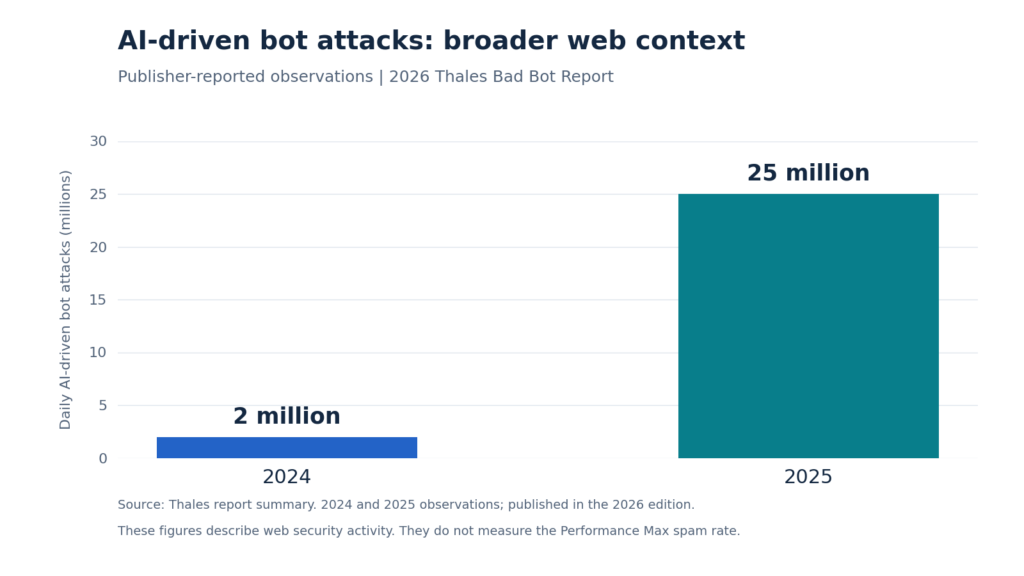
The wider web environment also makes form protection relevant. Thales’ 2026 Bad Bot Report, based on full-year 2025 activity, reports the following figures.
| Published finding | Reported figure | What it describes |
| Bot share of internet traffic | 53% | Broad web-traffic context |
| Bad-bot share of internet traffic | 40% | Malicious automated traffic |
| Observed daily AI-driven bot attacks, 2024 | 2 million | Publisher-reported attack volume |
| Observed daily AI-driven bot attacks, 2025 | 25 million | Publisher-reported attack volume |
These are the publisher’s broader security findings. They do not establish the percentage of Performance Max clicks or leads that are fraudulent. Diagnose your own campaign from your own records.
Begin the investigation with a sample of recent requests across campaigns, dates, and lead types. Compare submissions with validation results and CRM outcomes. Avoid selecting only the worst examples and treating them as the whole campaign.
A useful Google Ads management review should connect campaign reporting with actual lead quality and explain where the two diverge.
How to Stop Spam Leads in PMAX?
Protect the entry point where the suspicious requests arrive.
For website forms, start with the server that accepts submissions. A CAPTCHA displayed on the page is only one part of protection. Google’s reCAPTCHA documentation describes verifying the response token from the application’s backend; tokens are single-use and time-limited.
Have your developer confirm that invalid requests are rejected before being accepted as leads. Review every submission route, including form-plugin endpoints and connected booking tools.
The following controls address different problems. Test them together with the customer journey.
| Control | Purpose | Important limitation |
| Server-verified bot challenge | Check the submitted challenge response | Passing a challenge does not prove buying intent |
| Server-side field validation | Reject missing or malformed required information | Plausible information can still be misused |
| Rate limits | Restrict excessive submission activity | Shared networks and legitimate repeat users need consideration |
| Carefully tested honeypot field | Identify some automated form behavior | Autofill and accessibility behavior can create false positives |
| Email or phone verification, where suitable | Establish access to a contact channel | Channel access does not prove a legitimate service request |
| One or two relevant qualifying questions | Clarify service needs and suitability | Excessive friction can discourage real customers |
Choose questions that help your team make a decision: the service needed, the relevant ZIP code, or the intended project timeframe. Collect only information that serves a clear purpose.
A request for sensitive details, an identity document, or a long questionnaire is rarely the first repair a general contact form needs. Keep the process proportionate to the service.
Also test the conversion event. A click on “Submit” can occur before validation succeeds. A thank-you page can be refreshed. Two integrations may report the same action. Your accepted-lead event should correspond to a successfully accepted submission, with suitable protection against duplicates and tests.
For Google-hosted lead forms, your website’s CAPTCHA cannot protect the hosted form itself. Google provides “More volume” and “More qualified” optimization options; the latter adds submission steps and can change lead volume and cost. It still requires quality evaluation.
Good landing page design should make the offer clear and the contact process dependable. Test the full journey on mobile, including validation messages and successful delivery.
If your site uses WordPress, include form-plugin behavior, caching, and integration settings in the review. Improvements to WordPress website design should preserve a usable path for legitimate visitors while correcting the submission problem.
The objective is to reject inappropriate requests while allowing genuine customers to reach you comfortably. Review rejected submissions carefully enough to detect false positives, with appropriate access and retention controls.

Can You Add Negative Keywords on a Campaign Level to Performance Max Campaigns in Google Ads?
Yes. Current Google documentation supports campaign-level negative keywords for Performance Max. Account-level negatives are also available. These controls apply to Search and Shopping inventory.
That scope matters. A negative keyword is not a universal filter for every website, app, video, or form interaction.
Use exclusions to address demonstrated irrelevance. For example, a business selling a professional service may need to exclude employment-related searches if it does not intend to recruit through that campaign. Review match types and the effect on useful searches.
Different controls need different evidence.
| Finding | Relevant control | Scope to verify |
| Clearly irrelevant search queries | Negative keywords | Search and Shopping |
| Ads appearing on unsuitable named sites, apps, or videos | Placement exclusions | Supported account or manager-account settings |
| Ads sending visitors to inappropriate pages on your website | URL exclusions or Final URL expansion settings | Eligible landing-page destinations |
| Unwanted branded search traffic | Brand exclusions | Applicable Search and Shopping traffic |
| Inquiries outside the intended service area | Location targeting options | Presence settings and actual lead locations |
| Misleading or mismatched advertising text | Asset and text-customization review | Uploaded and automatically created assets |
Google states that Performance Max respects account-level and manager-account placement exclusions. Check the impact on other relevant campaigns when applying them.
Review landing destinations as well as placements. Google’s text-customization documentation explains that ads can use website content and that Final URL expansion can select another relevant page on the domain. URL exclusions help prevent traffic from being directed to inappropriate sections.
A careers page, an old promotional offer, or an ambiguous service description may explain why someone contacted you for the wrong reason. Inspect what was actually presented before assuming the request was automated.
For local services, review whether “Presence or interest” matches the business need. Google’s location options allow a presence-based approach for people in or regularly in the included locations. Location determination is not perfectly accurate, so continue checking real inquiry locations.
Use the channel performance report to examine delivery and results by channel. Google provides campaign summaries, channel distribution, and diagnostic information in that report.
Treat it as context for the investigation. It does not, by itself, certify that individual leads are genuine or prove which placement caused a particular false submission.
Can Someone Please Explain “Enhanced Conversions” and “Enhanced Conversions for Leads” in Layman Terms?
Enhanced conversions help connect advertising interactions with conversion outcomes using appropriate first-party information.
For a business that closes sales after a form submission, the important work is connecting the initial inquiry with what happened later: qualification, an appointment, or a sale. Enhanced conversions for leads supports measurement of those offline outcomes using imported data and hashed identifiers.
It is a measurement capability. Your business still has to determine whether the request is authentic and suitable.
Define qualification before configuring the import. Google distinguishes a qualified lead, assessed further in a CRM or internal system, from a converted lead that completes a chosen stage of the process.
The following is an example operating model. Adapt the stages to your business.
| Stage | Business meaning | Measurement approach |
| Accepted submission | A request reached the lead system successfully | Track separately from deeper outcomes |
| Validated inquiry | Relevant checks support an authentic request | Retain validation status and reasons |
| Qualified lead | The inquiry meets agreed commercial criteria | Consider as a bidding goal when reliably measured |
| Converted lead | The prospect completed the selected business milestone | Report the defined outcome accurately |
| Rejected, duplicate, or test | The record does not qualify for the intended stage | Keep it out of the qualified-lead import |
Next, inspect which goals the campaign actually uses.
Under standard goals, Google uses primary actions for bidding when the relevant goal is selected. Secondary actions are generally observational. A secondary action included in a custom goal can still be used for bidding, so changing the label alone may not remove an unwanted signal.
Ask for a documented explanation of the selected funnel stage. Avoid allowing raw submissions, button clicks, and qualified outcomes to count interchangeably as success.
Choose a stage with reliable, timely outcome data. If closed sales are too sparse or delayed, assess whether an earlier validated qualification stage provides a more usable initial bidding signal.
Giving a spam submission a zero monetary value also does not remove the submission from the event count. If the campaign optimizes conversion count, your chosen event definition still matters.
Use consistent CRM services for small businesses to support lead status, qualification reasons, ownership, and outcome reporting. A salesperson should be able to explain why a record changed stage.

How Can I Be Sure That the “Lead Value” Assigned Through the CRM Is Actually Getting Back to Google?
Verify the entire path from a real, authorized CRM outcome to the expected conversion action.
A CRM integration showing “connected” does not establish that current qualification events are being accepted and attributed. Inspect import activity, errors, identifiers, event times, conversion names, and the values received.
Google’s implementation guidance recommends including existing GCLIDs where possible and explains the role of user-provided identifiers. Requirements depend on the setup. Successful attribution should not be assumed for every record.
There is also an important 2026 integration change. Google’s documentation says migration of offline-conversion and enhanced-conversions-for-leads uploads to the Data Manager API begins June 15, 2026, with conditions for legacy access. Have your integration owner verify the route and eligibility instead of assuming that all older implementations still work—or that all have stopped.
Google Ads Data Manager provides a supported way to connect appropriate first-party sources and import outcomes. Review the supported connector, field mapping, and import behavior for your setup.
Trace a small, authorized sample through the pipeline:
- Locate the accepted inquiry and its permitted identifiers.
- Confirm when it reached the selected qualification stage.
- Check the outgoing event name, timestamp, value, and currency where relevant.
- Inspect import acceptance and diagnostics.
- Check the corresponding conversion action and reporting after the applicable delay.
For a custom connection, API development and integration services should include error handling, duplicate prevention, monitoring, and documentation.
Then evaluate economics at the same stage of the funnel.
Cost per qualified lead = advertising spend ÷ qualified leads.
A low raw cost per lead can coexist with a high cost per qualified opportunity. The following figures are illustrative arithmetic, not a Prevello case study or a measured improvement.
| Metric | Illustrative scenario A | Illustrative scenario B |
| Advertising spend | $6,000 | $6,000 |
| Submitted leads | 200 | 80 |
| Qualified leads | 20 | 32 |
| Qualification rate | 10% | 40% |
| Cost per submitted lead | $30 | $75 |
| Cost per qualified lead | $300 | $187.50 |
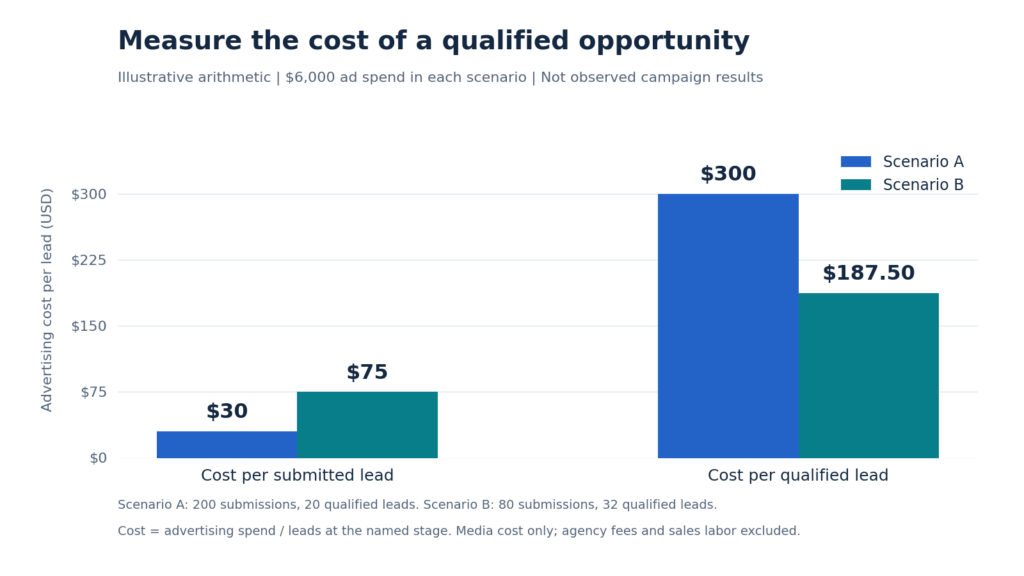
The example shows why volume alone cannot establish value. It does not predict what verification or campaign changes will achieve in your account.
Track media cost consistently, and show agency fees, verification costs, and sales labor separately when assessing total acquisition cost. Avoid silently changing the cost definition between reports.
Has Anyone Had Any Success Getting a Refund From Google Ads?
Google has processes for filtering invalid activity and issuing appropriate credits. A disappointing sales outcome does not automatically establish refundable invalid traffic.
Google’s current invalid-traffic guidance says activity identified before billing is removed from the relevant metrics and charges. Activity detected afterward can produce an invalid-activity credit where appropriate. Filtered-click counts and credit amounts represent different things.
If you suspect activity that was not filtered, Google’s guidance currently allows an investigation request covering the past 60 days. Prepare the evidence promptly.
| Evidence | Why it is useful |
| Customer ID and affected campaign names | Identifies the account and activity |
| Exact dates and unusual patterns | Defines the investigation period |
| Relevant GCLIDs | Helps connect records with ad interactions |
| Appropriate server and validation logs | Documents suspicious behavior |
| Lead assessments and contact outcomes | Explains why particular requests appear invalid |
Submit the request through the designated Google process and keep the records secure. An investigation or a third-party fraud score does not guarantee a credit.
This discussion concerns standard Performance Max campaigns. Campaigns with pay-per-lead goals, including the Local Services Ads transition described by Google, have their own lead and billing arrangements; check the rules for the actual campaign type.
Continue repairing form protection and measurement while the billing inquiry is reviewed. A possible credit cannot replace a functioning lead-quality process.
Can I Be Held Liable If There Is an FTC Complaint?
Responsibility depends on the facts, the applicable rules, and your role in the conduct. Hiring an agency does not remove the need to review how advertising, data collection, and follow-up operate.
For U.S. campaigns, separate the legal requirements from Google’s platform policies.
| Area | Relevant requirement or principle | Practical review |
| FTC advertising standards | Advertising must be truthful, non-deceptive, and supported; agencies can share responsibility | Check offers, qualifications, and performance claims |
| Telemarketing Sales Rule | Covered telemarketing has disclosure, consent, and Do Not Call requirements | Review lead provenance and outbound practices |
| TCPA and FCC rules | Applicable calls and texts have consent, Do Not Call, and revocation obligations | Evaluate the communication method and recipient |
| CCPA, for covered businesses | Relevant notices, privacy rights, and processing obligations apply | Review forms, data sharing, requests, and vendor arrangements |
| Google customer-data policies | Permitted measurement uploads have collection and use restrictions | Verify first-party data, disclosures, eligibility, and uploader compliance |
The FTC requires support for advertising claims and explains that agencies may have responsibility for misleading advertising. “Qualified leads” should have a documented meaning, and a claim of guaranteed spam elimination needs appropriate evidence.
The risk also extends to consumer treatment. In its September 2025 discussion of Citizens Disability, the FTC describes allegations involving deceptive lead-generation practices and unlawful telemarketing. Its guidance emphasizes legitimate consent methods and warns against knowingly assisting—or consciously avoiding knowledge of—unlawful conduct.
If someone says they never requested contact, investigate and stop inappropriate outreach. A plausible telephone number or a record labeled “consent obtained” is not sufficient reason to ignore the complaint.
Current FCC regulations impose prior-express-written-consent requirements on specified telemarketing calls using regulated technology, subject to scope and exceptions. They also address consent revocation for applicable calls and texts. Evaluate the actual setup rather than assuming every call follows the same rule.
For businesses covered by California’s CCPA, review applicable notices and sale-or-sharing opt-outs, including qualifying Global Privacy Control signals. California’s updated regulations took effect January 1, 2026, with provision-specific implementation schedules.
Google’s customer-data policies separately require appropriate disclosures and consent where legally required, and restrict measurement involving sensitive categories. Authorized third-party uploaders also have compliance obligations. Hashing contact details does not remove the need to assess these requirements.
Keep relevant consent and suppression records available to the people handling follow-up. Marketing automation services should reflect those choices so a rejected or opted-out contact does not continue through an inappropriate sequence.

How Long Did It Take to See the First Results?
Distinguish a verified technical fix from a measured improvement in campaign outcomes.
A validation change may immediately reject requests that fail its rules. That does not prove that the campaign is generating more qualified customers. A repaired CRM import may resume data delivery before bidding and business results change.
Google says Smart Bidding generally needs one to two conversion cycles to learn after conversion-goal or action changes; Performance Max circumstances can extend the adjustment. A conversion cycle is not a universal number of days.
Agree on the evaluation plan before changing the campaign.
| Phase | Priority | Evidence to review |
| Immediate triage | Classify suspicious requests and protect the budget | Lead sample, campaign settings, and contact complaints |
| Technical repair | Correct validation, tracking, and integration faults | Reproducible tests and accepted imports |
| Controlled evaluation | Monitor the selected qualified outcome | Comparable lead cohorts and complete conversion cycles |
| Budget decision | Retain, revise, reduce, or pause based on evidence | Qualified-lead cost, opportunity quality, and sales outcomes |
Set a budget you can afford during the investigation and define the conditions for reducing or pausing spend. An expectation of future learning should not prevent action when the campaign is producing no useful business outcomes.
Make follow-up timing part of the analysis. A real prospect may become harder to reach after a long delay. Use consistent review periods and allow inquiries enough time to be contacted and assessed before comparing quality.
Track rejected and unresolved records separately, so “we have not reached them” does not become “confirmed fraud.” Watch for lost legitimate submissions after introducing stricter validation.
After critical fixes, avoid repeatedly changing goals, targeting, creative, and budget together without recording why. A dated change log helps your team understand what improved, what worsened, and what remains uncertain.
If Performance Max still fails to meet your commercial goals under the agreed test conditions, assess whether a different campaign mix offers a better fit. The decision should reflect actual opportunities, operational capacity, and acceptable acquisition cost.
When discussing Prevello’s marketing services, bring recent lead-quality records, conversion settings, and evidence from the CRM. Those inputs support a focused review of where the lead journey is breaking down.
Your team should be able to open a lead notification with a reasonable expectation that someone needs what you offer. The recovery plan should move the business toward that result: authentic inquiries, appropriate follow-up, dependable measurement, and advertising decisions you can explain.