
The proposal says “$2,500 per month.” You think you can make that work.
Then you ask about advertising. That is separate. The landing page needs a project fee. There are software subscriptions, a setup charge, and additional creative work that was not part of the monthly package.
Suddenly, you are calculating a very different budget.
What am I actually buying? How much will leave my bank account over the next three months? And how will I know whether it was worth it?
Those are reasonable questions. An agency fee can be clearly stated while the complete cost of running the plan remains unclear.
Perhaps you have already paid for marketing that produced impressive reports and disappointing inquiries. You do not want to repeat that experience. You also do not want to reject useful help simply because the proposals are difficult to compare.

The actual cost of a marketing agency includes its fees, the spending required to carry out the plan, and any agreed setup, production, technology, and transition costs. Your own team’s time belongs in the evaluation too.
Before signing, ask for the total expected budget, what each charge buys, what can change, and which outcomes will be measured. This guide gives you a practical way to have that conversation using current pricing references, worked examples, and the U.S. requirements relevant to agency claims and billing transparency.
How Much Should I Be Paying for a Marketing Agency?
Start with the scope of work, then use published prices as context.
A campaign-management service, a website project, and a complete marketing program involve different responsibilities. Comparing their headline prices without comparing the work can lead you to an expensive misunderstanding.
Clutch’s current U.S. digital-marketing directory publishes these broad ranges: 3,000–15,000+ per month for multi-channel retainers, 10,000–100,000+ for project engagements, and 100–250 per hour for strategy and senior specialists.[^1]
These are marketplace-published reference ranges. They are not minimum fees, price caps, or a quote for your business.
| Published reference | Reported figure | Scope to understand |
| Clutch: U.S. multi-channel retainers | 3,000–15,000+ monthly | Broad programs covering several marketing activities |
| Clutch: U.S. project engagements | 10,000–100,000+ | Examples include audits, launches, and migrations |
| Clutch: U.S. strategy and senior specialists | 100–250 hourly | Expertise and staffing affect the rate |
| Clutch: overall digital-marketing listings | 25–49 hourly | A broader listing population, not a U.S.-only benchmark |
| Promethean: latest surveyed agency rate band | 29% charged 175–199 hourly | A share of survey respondents, not a universal average |
Clutch’s broader October 2026 guide reports the 25–49 hourly band for its overall digital-marketing listings. Do not treat that global listing figure as the expected price of a U.S. senior specialist.[^2]
Promethean Research’s 2026 Digital Agency Industry Report says 29% of agencies in its latest survey charged 175–199 per hour. It also reports that the share raising rates was 22% in 2024, 28% in 2025, and 20% in 2026.
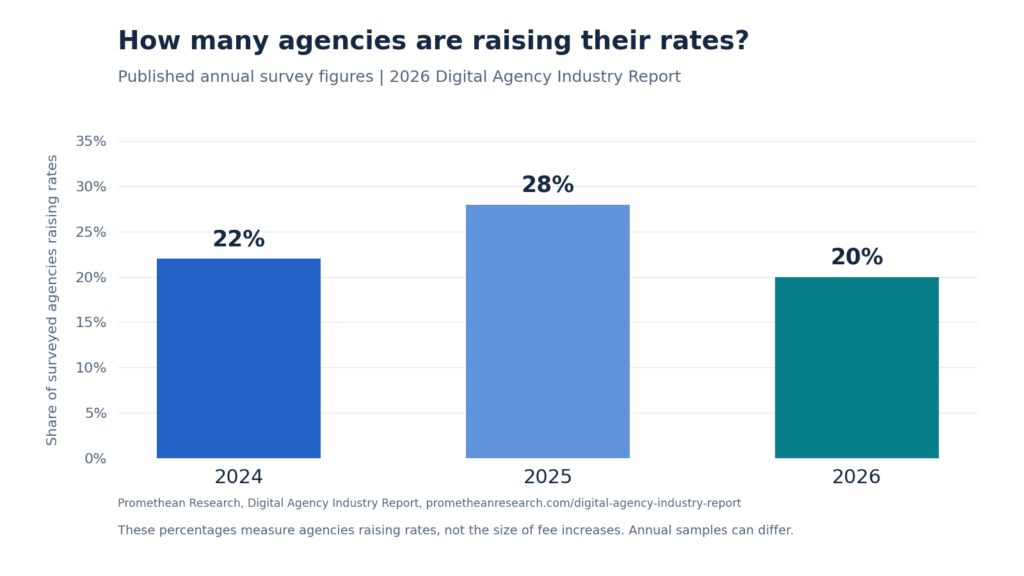
Those percentages describe agencies raising rates. They do not measure the size of a price increase, and they do not establish that prices fell for the remaining agencies. Annual survey populations can differ.
A narrower engagement may cost less than a broad program. A complex account may cost more. Ask the provider to explain the relationship between its quote, the workload, and the business problem it will address.
Your question is ultimately whether the proposed scope is useful and affordable for your business.
What Do I Really Need in a Third Party Marketing Company?
Identify the problem you want the agency to solve before buying a collection of services.
A local business with a broken inquiry form may need a focused website and measurement repair. An established company with reliable lead handling may need stronger demand generation. A business entering a new market may need research, positioning, creative production, and campaign execution.
The same package will not serve each situation equally well.خ۸
Use a scope table to turn broad labels into work your team can review.
| Service area | What to clarify in the proposal | Evidence of delivery |
| Strategy | Audience, offer, priorities, assumptions, and research | A usable plan with explained decisions |
| SEO | Technical work, content responsibilities, and implementation | Documented changes and relevant performance reporting |
| Paid advertising | Platforms, campaign work, testing, and budget responsibilities | Account records, change history, and outcome reporting |
| Content and creative | Formats, quantities, revisions, approvals, and licenses | Approved assets with the agreed usage rights |
| Website and landing pages | Research, writing, development, testing, and maintenance | Working pages and completed customer tasks |
| CRM and follow-up | Routing, qualification, integrations, and team training | A functioning lead process and accessible records |
For SEO services, distinguish recommendations from implementation. An audit listing problems is a different deliverable from correcting them.
For landing page design, establish whether copywriting, development, tracking, and ongoing experiments are included. A design file alone may not deliver the live page your campaign needs.
Clarify who does the work and who approves it. Ask how much access to senior expertise the engagement provides, which responsibilities sit with your staff, and whether specialist production is subcontracted.
Include your team’s time. Gathering source material, reviewing copy, approving creative, and updating lead statuses may be necessary. If nobody inside the business can do that work, the delivery plan needs to account for it.
This is where some of the frustration begins: the agency considers the work delivered while the owner believes the promised business improvement has barely started. Written responsibilities and acceptance criteria help prevent that mismatch.

How Common Is It for Agencies to Charge a Percentage of Ad Spend for Campaign Management?
A percentage of advertising spend is one available pricing model. Retainers, projects, hourly work, and performance-linked fees are other options.
The useful comparison is what each arrangement charges for and what happens when the scope or spending changes.
| Pricing model | How the fee works | What to confirm |
| Monthly retainer | A recurring charge for agreed work or capacity | Deliverables, limits, unused capacity, and extra-work rates |
| Fixed project fee | A price for a defined project | Milestones, revisions, assumptions, and change orders |
| Hourly or time and materials | Payment for time used at agreed rates | Estimates, role-based rates, reporting, and approval caps |
| Percentage of ad spend | A fee calculated from a defined spending base | Minimums, tiers, caps, and the precise calculation base |
| Performance-linked or hybrid | A fee partly connected to an agreed result | Attribution, qualification, refunds, and measurement disputes |
Consider an illustrative management arrangement charging 15% of media spend, subject to a $1,000 monthly minimum.
At $5,000 in media spend, the percentage calculation is $750. The minimum makes the management fee $1,000, so media plus management totals $6,000 before other costs.
At $20,000 in media spend, 15% produces a $3,000 management fee, so those two components total $23,000.
These figures explain the arithmetic. They are not a recommended percentage or Prevello’s pricing.
Ask whether the fee is based on actual platform charges, the planned budget, gross billings, or another amount. Clarify treatment of taxes, credits, unused budgets, and agency-funded spending.
Also ask how budget increases are authorized. When compensation rises with spend, the provider should explain why additional investment is commercially justified.
For Google Ads management, review the fee alongside campaign complexity, conversion measurement, creative responsibilities, and ongoing optimization. The percentage alone cannot establish whether the service is expensive or effective.
A performance-based offer needs equally careful review. Define which leads qualify, which sales are attributed, whether existing customers count, and how cancellations are handled. A promise to charge “only for results” can still leave your business paying for advertising, tools, and production.
Agency Hiding Fees in Media Spend?
Ask for a breakdown that lets you reconcile agency charges with platform spending.
A bundled invoice can be convenient. The important issue is whether you can understand how much went to the advertising platform and how much paid for management and other services.
Google’s third-party transparency policy requires management-fee disclosure, including written information before a new customer’s first purchase and disclosure on customer invoices. Where the applicable reporting terms require cost reporting, the amount charged by Google must be reported separately from the partner’s fees.[^4]
These are Google’s platform requirements. They should be considered alongside the agreement and applicable law.
Costs worth clarifying extend beyond campaign management.
| Potential charge | Why it may exist | Question to ask |
| Onboarding or setup | Research, access, configuration, and initial launch work | What specific work does the fee cover? |
| Creative production | New copy, images, video, or variations | What is included, and what requires additional approval? |
| Website changes | New pages, forms, or technical implementation | Is this a separate project or part of the retainer? |
| Software and call tracking | Tools required for measurement and operations | Who holds the subscription, and can it be retained? |
| Additional work | Tasks beyond the agreed scope | How are price and approval documented before work starts? |
| Transition work | Exports, documentation, training, or provider handover | What is included at the end of the engagement? |
An additional charge can be legitimate when the underlying work and price are clearly agreed. Trouble begins when the buyer discovers the charge after relying on a different understanding of the package.
For Meta Ads management, clarify the creative plan. Management of an account and production of a continuing supply of usable ads are distinct responsibilities that may be priced together or separately.
Ask about third-party commissions, referrals, rebates, and markups where relevant. Establish what the provider retains and what is credited to your business.
Get approval rules in writing. Your team should know who can authorize additional spending, the financial limit of that authority, and how changes affect the total budget.
How Much Money Do You Spend on Marketing?
Build the complete budget before judging whether the retainer is affordable.
Start with four categories: recurring agency work, media spend, recurring tools or production, and one-time work. Add applicable taxes, payment charges, and internal labor where relevant.
The following is an illustrative three-month plan, not a market-average package or a Prevello quotation.
| Cost component | Recurring monthly amount | One-time amount | Three-month total |
| Agency service fee | $2,500 | — | $7,500 |
| Advertising spend | $5,000 | — | $15,000 |
| Software and tracking | $300 | — | $900 |
| Additional creative allowance | $200 | — | $600 |
| Onboarding and setup | — | $1,800 | $1,800 |
| Landing-page project | — | $1,200 | $1,200 |
| Total | $8,000 | $3,000 | $27,000 |
Under these assumptions, the first month requires $11,000, followed by $8,000 in each of the next two months.
The $2,500 agency fee represents one part of the plan. Taxes, your own staff time, and other unlisted expenses are excluded from this example.
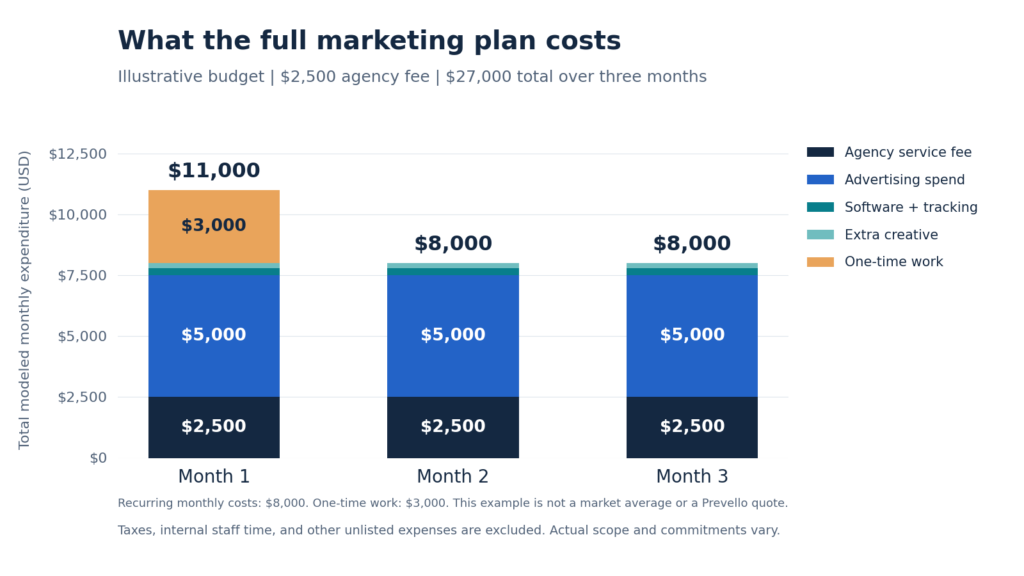
If the recurring amounts continued for twelve months and the one-time work occurred once, the modeled annual total would be $99,000. That projection depends on unchanged scope and spending.
Separate planned expenditure from contractual commitments. Advertising may be adjustable while the agency fee remains payable during a notice period. Some tools renew annually. A website project may have milestone obligations even if a campaign pauses.
Ask the provider to show a base plan, optional additions, and the conditions that could increase costs. Keep a reserve for agreed experiments or unexpected implementation needs, with approval limits.
Consider cash timing as well. Paying for acquisition this month does not mean every resulting sale will close or be collected this month. The budget should reflect your sales cycle and ability to fund the evaluation period.
You should be able to explain the expected expenditure to a business partner or finance team without translating a vague “growth package” into guesses.
Are Marketing Agencies Worth It for Things Like Email/SMS or Meta/Google Ads?
They can be useful when the work improves outcomes that matter and the economics support the cost. Evaluate the whole system rather than one attractive dashboard number.
Return on ad spend typically compares attributed revenue with media spending. That ratio does not subtract the agency fee, fulfillment costs, software, or other expenses.
A campaign can show substantial revenue and still make little contribution to the business after its costs are considered. Attribution also does not automatically prove the sales were caused by the campaign.
Use consistent definitions and evaluate the same customer cohort over a suitable period.
The next example is hypothetical arithmetic. Assume $24,000 in genuinely additional revenue, a 40% contribution margin after variable fulfillment costs but before marketing, and $8,000 in total recurring marketing expenditure.
| Calculation | Illustrative result | What it means |
| Revenue ÷ $5,000 media spend | 4.8× | A media-only revenue ratio |
| $24,000 × 40% contribution margin | $9,600 | Contribution before marketing expenditure |
| $9,600 − $8,000 marketing expenditure | $1,600 | Amount remaining before fixed overhead and taxes |
| $8,000 ÷ 40% contribution margin | $20,000 | Additional revenue needed to cover modeled marketing cost |
| $8,000 ÷ 12 new customers | $666.67 | Marketing cost per new customer under these assumptions |
The $1,600 is not net profit. The model excludes one-time setup costs, fixed overhead, taxes, and any other unlisted expenses.
Change the margin, the customer count, or the degree of incrementality, and the conclusion changes. A useful report makes those assumptions visible.
For lead-generation businesses, connect inquiries with qualified opportunities, appointments, completed sales, and contribution. Duplicate submissions or unsuitable requests should not be treated as equivalent to customers.
Reliable CRM services for small businesses can help connect lead sources, qualification, follow-up, and sales outcomes.
Measure the agency’s contribution fairly. Your team still influences response time, sales conversations, service quality, and retention. If marketing and sales responsibilities are unclear, a weak outcome can turn into an argument about who is to blame.
Agree on the baseline, evaluation window, and actions that follow disappointing results. An owner should receive an explanation of what the evidence shows, what remains uncertain, and what will be changed.

Is It Worth Trying to Push Back on the Terms Now, or Are Signed Agency Contracts Set in Stone?
Terms may be negotiable, but your obligations and available rights depend on the agreement, applicable law, and circumstances.
Raise concerns promptly and document any agreed amendment. Do not assume that a disappointing campaign automatically removes notice requirements or makes every charge refundable.
The commitment can affect the actual cost as much as the monthly fee.
| Contract term | What to establish | Why it affects cost |
| Minimum commitment | Start date, end date, and services covered | Determines the initial payment obligation |
| Renewal | Whether renewal is automatic and how notice works | Can create another commitment |
| Termination | Notice method, timing, fees, and remaining work | Determines the cost and process of leaving |
| Scope changes | Approval, pricing, and effect on delivery dates | Controls additional invoices |
| Accounts and assets | Access, deliverables, licenses, and ownership terms | Affects continuity and potential rebuilding costs |
| Data handling | Permitted processing, security, exports, and retention | Affects compliance and handover work |
Current U.S. requirements also need to be applied within their actual scope.
| Rule or framework | Relevant principle | Application to agency purchasing |
| FTC advertising standards | Claims must be truthful, non-deceptive, and supported | Review pricing representations and promised performance |
| FTC Rule on Unfair or Deceptive Fees | Covers live-event tickets and short-term lodging | It is not a general fee rule for every agency contract |
| California SB 478 | Addresses covered consumer pricing; commercial-use purchases are excluded | Do not automatically apply it to a business marketing contract |
| California CCPA regulations | Covered processing relationships have specific obligations | Assess applicable client-data work and vendor responsibilities |
| Google third-party policies | Require relevant cost and management-fee transparency | Apply to providers managing Google advertising within policy scope |
The FTC’s advertising guidance requires substantiation for claims and explains that agencies can share responsibility for misleading advertising. A promise of guaranteed revenue, rankings, or a particular financial return needs appropriate support.[^5]
The FTC fee rule took effect May 12, 2025, covering pricing for live-event tickets and short-term lodging, including covered business purchases. It does not impose the same requirements on every ordinary marketing-services agreement.[^6]
California’s Attorney General likewise explains that SB 478 does not apply to purchases for commercial use. Consumer pricing headlines should not be mistaken for a universal right governing your agency contract.[^7]
For businesses and processing arrangements covered by California’s CCPA, assess the relevant contractual and data-handling responsibilities. Updated regulations took effect January 1, 2026, with separate schedules for some provisions.[^8]
If a proposal includes a compliance charge, request the specific work, responsible party, and deliverable. An unexplained “compliance fee” does not establish that the promised work is necessary or complete.
When reviewing marketing automation services, include data access, communication preferences, suppression records, and the handover of workflows in the scope.
Also clarify whether delivered creative can be reused and modified, and which components depend on third-party licenses. Paying an invoice should not be your only evidence of the rights and access needed to continue operating.
If material terms, access, or charges are disputed, obtain advice based on the actual documents and governing jurisdiction before making an irreversible decision.
How Do You Really Choose a Marketing Agency That’s Worthy of Investment?
Request proposals against the same brief.
Explain the business objective, current constraints, available information, budget, and internal responsibilities. Then ask each provider to specify the work, costs, assumptions, and measurement plan.
Use a comparison table instead of relying on which presentation feels most reassuring.
| Comparison point | What a reviewable proposal provides |
| Business objective | A defined problem and commercially meaningful outcomes |
| Scope | Specific responsibilities and deliverables |
| Staffing | Who performs the work and how specialist support is used |
| Full budget | Agency fees, media, tools, production, and one-time work |
| Extra spending | Rates, limits, and approval requirements |
| Measurement | Definitions, baseline, reporting, and evaluation period |
| Continuity | Account access, asset rights, data, and transition responsibilities |
| Commitment | Renewal, notice, termination, and remaining obligations |
Ask the agency to explain what it would prioritize if your budget were smaller. That conversation can reveal whether it understands the problem well enough to focus the work.
Consider a limited, well-defined engagement when the situation is uncertain: an audit with usable recommendations, a measurement repair, or a focused implementation project. Make the deliverable and acceptance criteria explicit.
Request relevant evidence of past work, with enough context to assess the claims. A revenue screenshot without spending, margin, timeframe, or attribution context gives an incomplete picture.
Also assess how the provider handles an uncomfortable question. You should be able to ask about a fee, a result, or an account without being made to feel unreasonable.
When discussing Prevello’s marketing services, start with the growth problem and request a clearly scoped plan showing the required work, expected costs, and useful success measures.
A price you can afford is only the beginning. The agreement should also let you understand what you are buying, control additional expenditure, and assess whether the work is helping your business.
That clarity changes the experience of paying an agency invoice. You can connect the charge to agreed work and evaluate the investment with evidence, instead of wondering what the next bill will reveal.